South For Jack's River near Pinhoti Trail Terminus - Georgia section (credit Dave Meeks)
My grandfather used to say that fall starts July 5th.
As a child, I never quite understood what he meant. July 5th is the heart of summer. The days are long, the woods are green, and throughout the South, some of the hottest weeks of the year may still be ahead.
But the older I get—and the more time I spend in the mountains—the more I understand.
He wasn’t talking about temperature.
He was talking about the direction nature was moving.
From the first stirrings of spring through early summer, nearly everything in the Southern Appalachians seems to be in a race to grow. Buds open. Leaves unfurl. Wildflowers emerge. Birds nest and raise their young. Ferns push upward from the forest floor. The forest canopy closes overhead.
Everything seems to be reaching outward—toward sunlight, warmth, reproduction, and growth.
By the Fourth of July, much of that great annual push has reached its height.
Then something subtle begins to happen.
The forest is still lush. The days are still hot. Cicadas are still singing. But nature has begun to change direction.
Plants increasingly turn their energy from rapid growth toward maintaining what they’ve built, producing seeds and fruit, and storing resources. Birds finish nesting, and some begin preparations that will eventually lead to migration. Trees continue gathering energy through their leaves, but the seemingly endless expansion of spring and early summer begins to slow.
Nature begins, almost imperceptibly, to pull back and conserve.
And the sun is doing the same.
The summer solstice has passed. Each sunrise comes a little later. Each sunset arrives a little earlier. At first, the difference is measured in minutes and is easy to miss.
But the direction has changed.
Perhaps that was what my grandfather noticed.
July 5th wasn’t the beginning of fall weather. It was the beginning of the long turning toward fall.
By August, the clues become easier to find. By September, they’re all around us on the Benton MacKaye Trail.
A cooler morning.
A longer shadow.
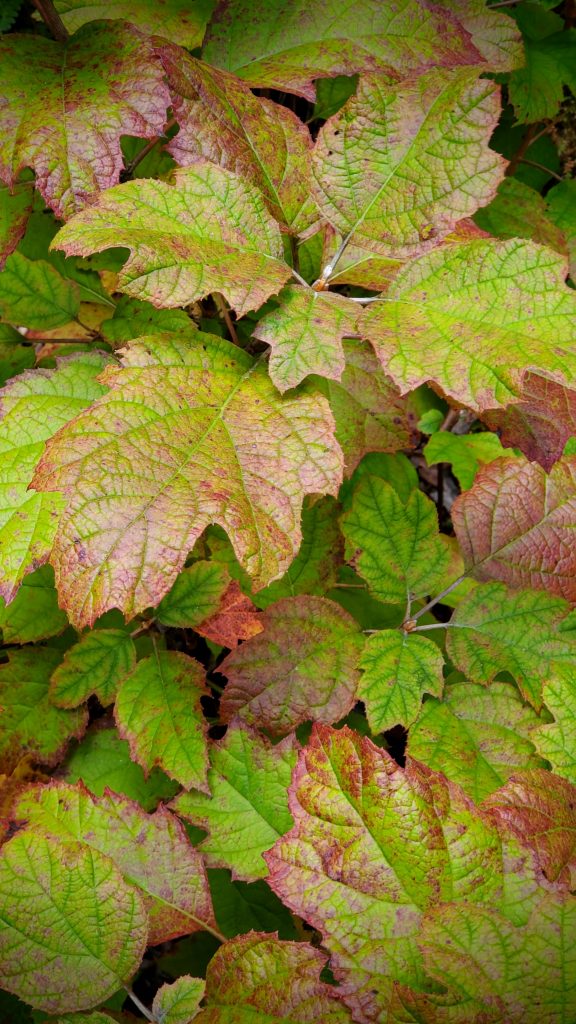
A sourwood beginning to turn crimson.
A yellow leaf floating down a mountain stream.
And somewhere along the nearly 300 miles of the BMT, autumn has already begun.
Muscadine vine (credit Dave Meeks)
Fall Doesn’t Arrive All at Once
We tend to think of fall in the Southern Appalachians as an event.
We wait for “peak color.” We check foliage forecasts. We plan trips around a particular weekend in October when the mountains are expected to explode into reds, oranges, and golds.
But autumn doesn’t work that way.
It arrives gradually.
On the Benton MacKaye Trail, fall is a journey that unfolds across differences in elevation, exposure, rainfall, temperature, and even individual species of trees.
Long before entire mountainsides change color, there are hints.
A sourwood flashes crimson at the edge of the forest.
A dogwood takes on a dusty red.
Virginia creeper begins glowing against a tree trunk.
Tulip poplar leaves turn yellow and drift onto the trail.
Goldenrod appears in sunny openings while asters announce that another season is approaching.
The transformation is already underway.
You just have to look closely enough to see it.
credit Dave Meeks
From Growth to Gathering
One of the pleasures of hiking the same landscape throughout the year is watching its priorities change.
Spring is about emergence.
Early summer is about growth.
Early fall is about preparation.
By September, the evidence is increasingly visible along the BMT. Berries and fruits have replaced many spring blossoms. Acorns and nuts are developing and beginning to fall. Plants that spent spring sending energy into leaves and stems are now producing and dispersing seeds.
Wildlife responds in turn.
Food becomes something to gather rather than simply something abundant. Migratory birds begin responding to shortening daylight. Bears become increasingly focused on finding calories as the season progresses.
The forest hasn’t stopped living.
Far from it.
But its energy feels different.
Spring reaches outward. Fall gathers inward.
And early fall is the fascinating period when you can watch that transition happening in real time.
Atop Flat Top mountain, Georgia Section (credit Dave Meeks)
September: The In-Between Season
September may be one of the most overlooked months on the BMT.
It doesn’t have the fresh wildflowers of April or the famous foliage of late October. But it offers something entirely its own.
September is the bridge between seasons.
Summer still holds the valleys, particularly during the afternoon, but the mountains increasingly belong to fall.
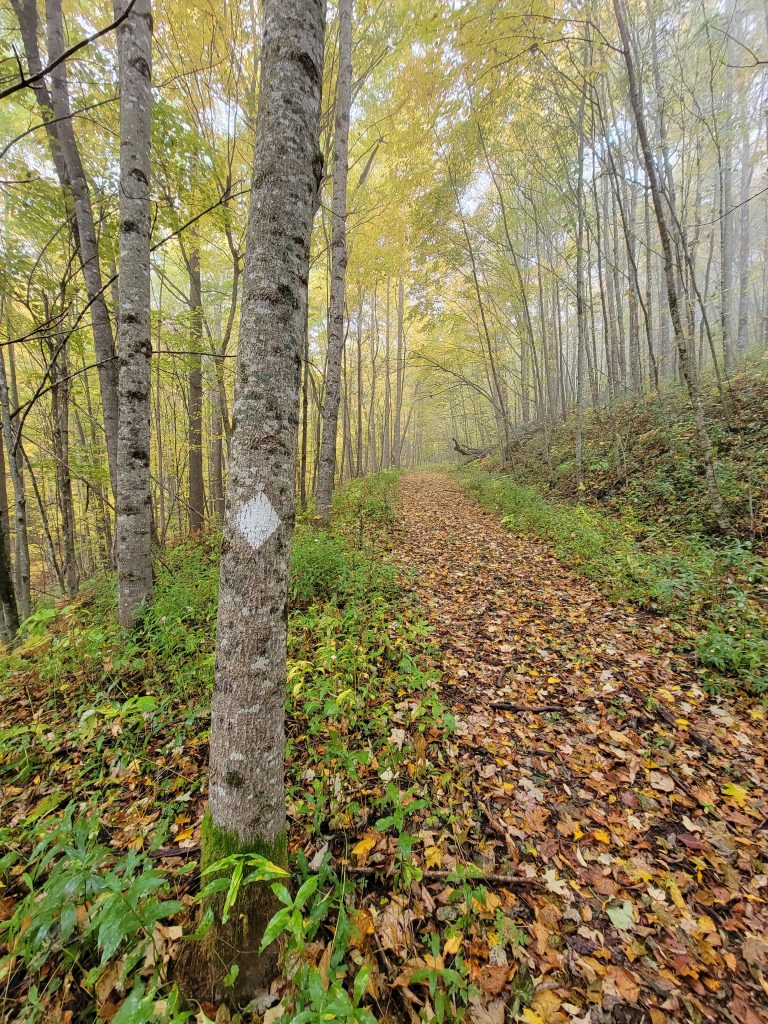
Early mornings can bring cooler temperatures and mist rising from creeks and rivers. At higher elevations, hikers may encounter crisp air that seems weeks ahead of the communities below.
The forest canopy remains overwhelmingly green, but it is no longer the uniform green of midsummer.
Look carefully and the palette has begun to change.
That contrast can make September especially beautiful for photography: a single red maple surrounded by green forest, yellow leaves scattered across dark trail tread, or early morning fog settling into valleys that remain lush from summer.
These aren’t the grand landscapes of peak foliage.
They’re quieter photographs.
And sometimes they’re more interesting because of it.
Tennessee Section (credit Dave Meeks)
Follow Fall Up the Mountain
Elevation is one of the great storytellers of autumn in the Southern Appalachians.
As temperatures begin to cool, higher elevations generally show seasonal changes earlier than the valleys. That means a September hike can sometimes feel like walking forward and backward through the seasons.
Climb high enough and you may encounter the first signs of autumn.
Descend toward a creek and summer seems to return.
This progression becomes even more dramatic as the season advances. Color typically begins at higher elevations and gradually works its way down the mountainsides, eventually reaching the lower valleys later in fall.
The BMT is particularly well suited to experiencing this transition because it crosses such varied terrain through Georgia, Tennessee, and North Carolina.
Instead of thinking about a single “peak” weekend, think of fall as something you can follow.
The trail will show you where the season is.
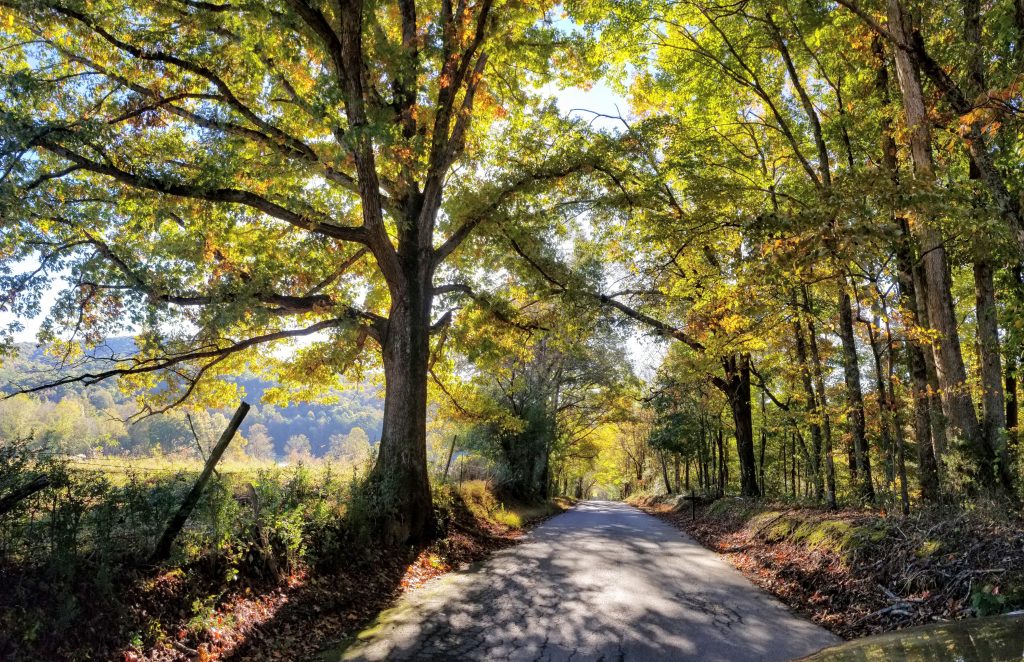
Bushyhead Road, Georgia section (credit Dave Meeks)
The Changing Light
Some of the first signs of fall aren’t found in the leaves at all.
They’re found in the light.
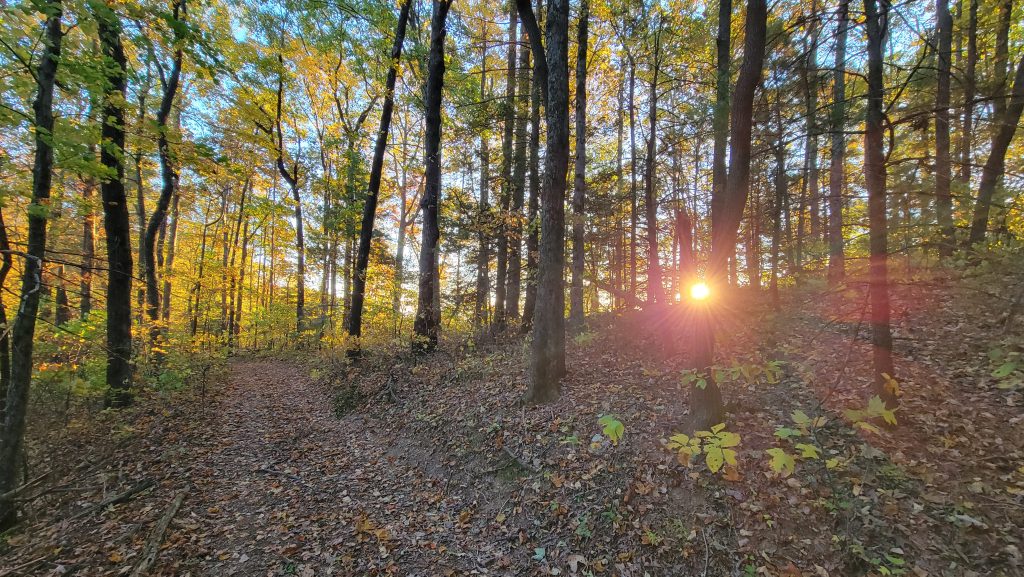
September sunlight arrives at a lower angle than the intense overhead sun of midsummer. Mornings and evenings take on a warmer quality, and shadows become longer and more pronounced.
For hikers, that can transform familiar places.
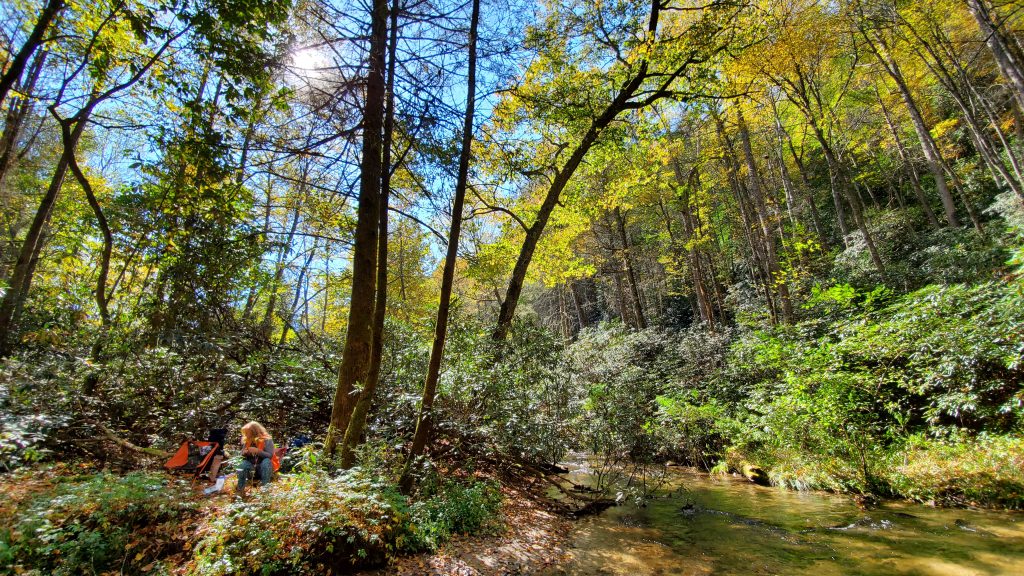
A creek you’ve crossed many times suddenly catches golden light between the trees.
A ridgeline becomes layered in morning haze.
Sunlight breaks through the canopy and illuminates a patch of ferns or a single turning leaf.
For photographers, early fall offers something peak foliage sometimes cannot:
Subtlety.
Instead of trying to capture an entire mountainside at maximum color, September encourages us to notice smaller changes.
One leaf.
One shaft of light.
One patch of color.
One misty morning.
Those details tell the story of a season arriving.
Listen and You’ll Hear Fall, Too
Early autumn isn’t only something we see.
The mountains begin to sound different.
The tremendous chorus of summer insects continues, but gradually changes. Bird activity shifts as migration gets underway. Acorns begin dropping through the canopy. Drying leaves rustle differently beneath your boots.
Creeks can sound louder in the quieter morning air.
And as September progresses, the forest slowly begins opening.
These changes are easy to miss when hiking becomes a race toward a destination.
But the Benton MacKaye Trail has never been a trail that demands speed.
It rewards attention.
Stop occasionally.
Listen.
The season may reveal itself before you see it.
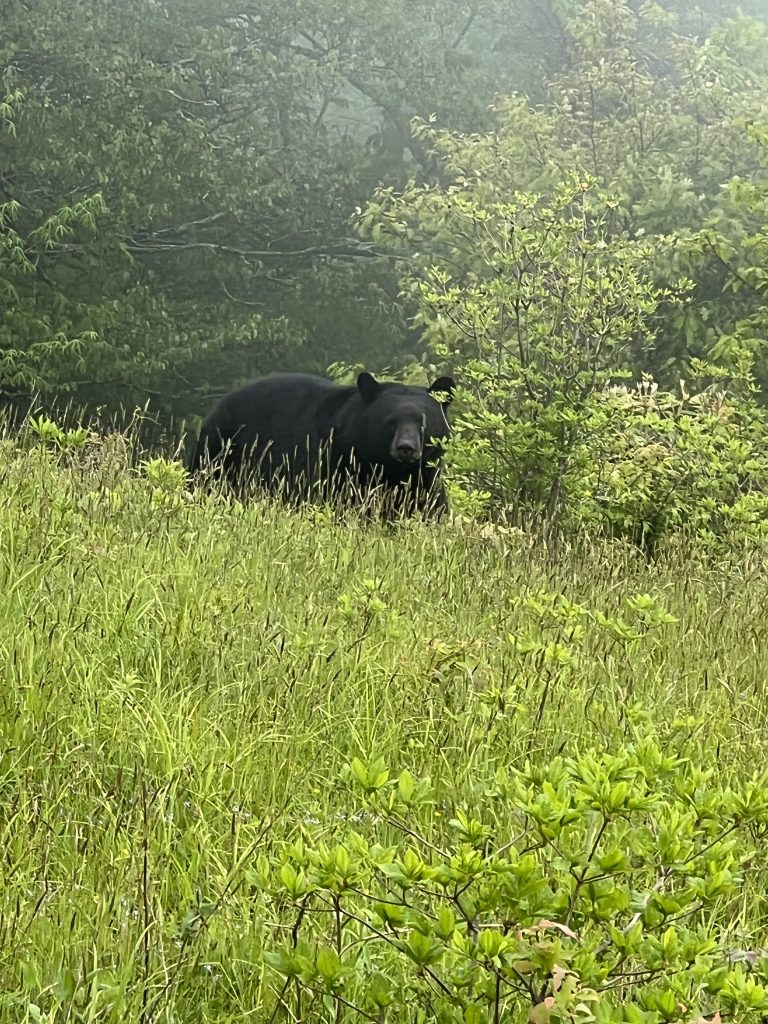
Bear atop Bob Bald, North Carolina Section (credit Ryon McCabe)
Wildlife Knows What’s Coming
While we’re checking calendars, the natural world is already preparing for the months ahead.
September is an active period for wildlife throughout the Southern Appalachians. Bears are increasingly focused on finding calories as they prepare for winter. Hard mast—including acorns and other nuts—becomes an important food source for many species.
Deer, wild turkey, squirrels, and countless smaller animals respond to the changing availability of food.
For hikers, this makes responsible wildlife practices especially important.
Keep food properly secured. Give wildlife plenty of space. Never intentionally approach or feed animals. And remember that seeing a bear along the trail is an opportunity to observe a wild animal—not an invitation to move closer for a photograph.
Early fall reminds us that the BMT isn’t simply a recreational corridor.
It passes through functioning ecosystems whose inhabitants are responding to the same seasonal signals we are.
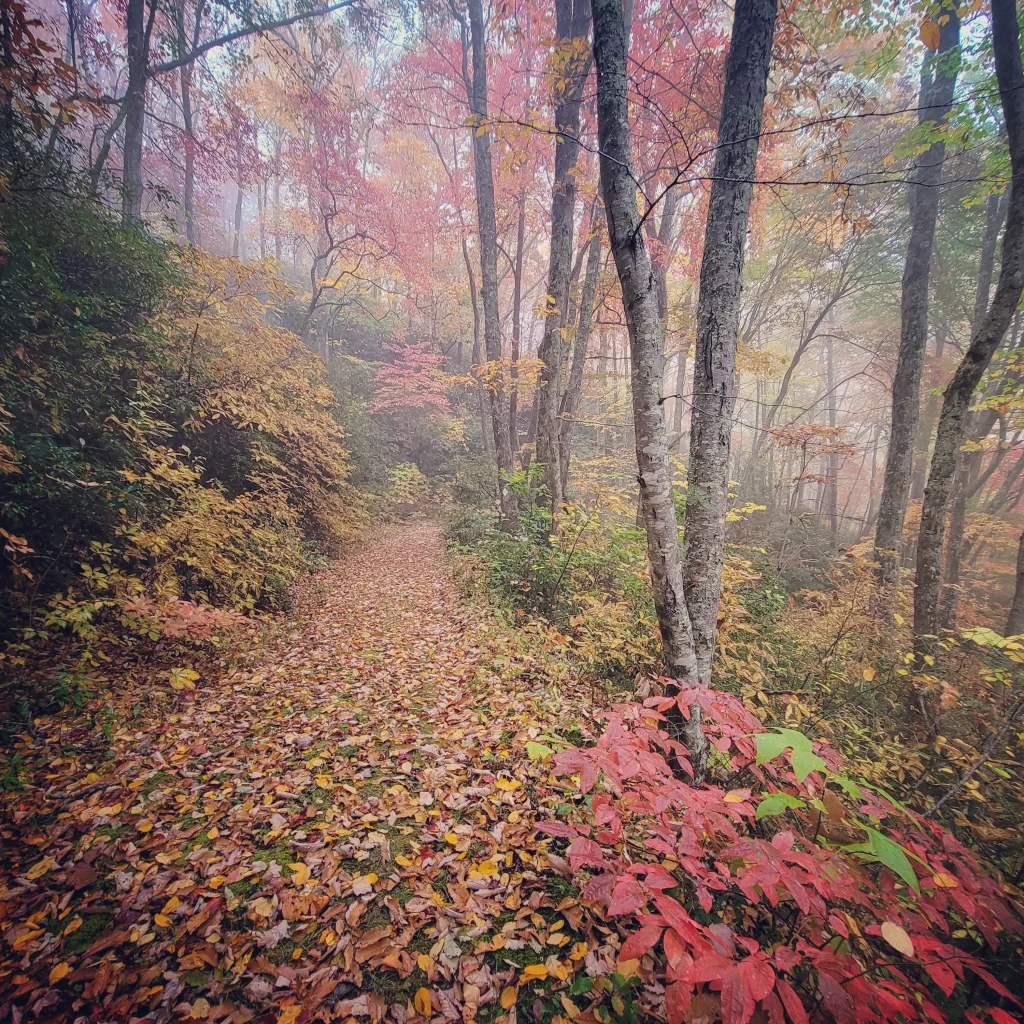
Tennessee Section (credit Dave Meeks)
A Photographer’s Season
I have spent many hours photographing fall along the Benton MacKaye Trail, and one of the things photography has taught me is that autumn is much bigger than peak color.
Some of my favorite images aren’t necessarily from the brightest days of October.
They’re from the transition.
Fog drifting through a valley.
A trail disappearing beneath the first fallen leaves.
Early color reflected in moving water.
A splash of red against an otherwise green mountainside.
Morning light filtering through a canopy beginning to thin.
Photography forces us to notice these moments.
But you don’t need a camera to experience them.
Sometimes the best thing you can do is stop walking for a minute and simply look around.
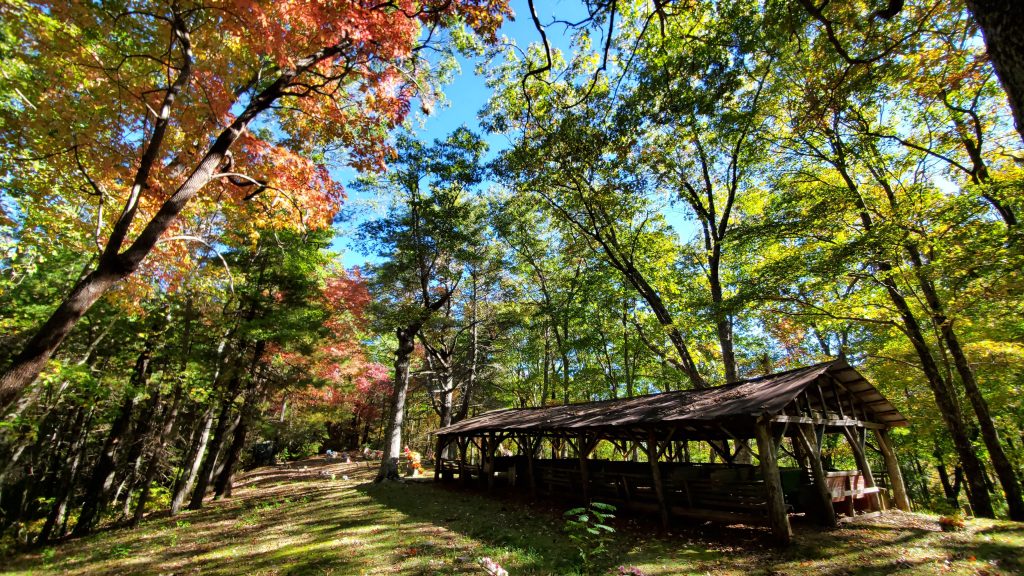
Dyer Gap cemetary, Georgia section (credit Dave Meeks)
Don’t Wait for Peak
Every fall, hikers ask the same question:
When will the leaves peak?
It’s understandable. Peak foliage in the Southern Appalachians can be spectacular.
But concentrating an entire season into one weekend misses much of what makes autumn remarkable.
There is no single perfect day.
There is the first cool morning.
The first red leaf.
The first time you notice that the forest looks different than it did last week.
There is September mist, October color, and eventually the open forests and long-distance views that arrive after the leaves have fallen.
Each is part of autumn.
And each is worth experiencing.
Tennessee section (credit Dave Meeks)
Early Fall Is a Wonderful Time to Hike the BMT
September also brings practical advantages for hikers.
Temperatures generally begin moderating, particularly in the mornings and at higher elevations. Summer humidity slowly loosens its grip. The days remain long enough for substantial hikes, while cooler conditions can make climbing more comfortable.
But early fall still requires preparation.
Warm afternoons remain possible. Thunderstorms don’t disappear simply because the calendar says September. Daylight is steadily shortening, and temperatures can vary significantly between valleys and high ridges.
Carry adequate water, check the forecast, bring layers, know when sunset occurs, and leave your hiking plans with someone before heading into remote sections of the trail.
Most importantly, don’t allow beautiful weather to replace good judgment.
The BMT remains a backcountry trail in every season.
Near Hemptop, Gergia section (credit Dave Meeks)
The Season Between the Seasons
Perhaps that is what my grandfather understood.
Fall doesn’t begin when the calendar tells us it does.
It doesn’t begin when a television meteorologist announces peak foliage.
And it certainly doesn’t begin when the first pumpkin appears on a store shelf.
The real transition begins much earlier.
For months, the mountains have been rushing outward—budding, blooming, nesting, growing.
Then, sometime around the height of summer, the direction begins to reverse.
Growth slows.
Seeds mature.
Animals prepare.
Daylight retreats.
The forest begins the long process of gathering its resources and preparing for what comes next.
By September, those subtle changes have become a season we can see, hear, and feel.
So this year, don’t wait for peak color.
Walk the BMT while summer and autumn are sharing the mountains.
Look for that first red leaf among a thousand green ones. Watch fog rise from a creek on a cool morning. Notice how much longer the shadows have become. Pay attention to what is fruiting, what is falling, and what has stopped growing.
Because autumn’s first act isn’t a mountain covered in red and gold.
It’s a change in direction.
And perhaps that’s what my grandfather meant all along when he said:


 Subscribe via RSS